Category: Vintage Fabrics

  • Storytelling Fabrics Collection

    Storytelling Fabrics Collection

    My Nanna Betty taught me to sew when I was a little girl. While we stitched, she told me stories about growing up in Salford: cobbled streets, smoky chimneys, the factory where she worked, and the day she was crowned Rose Queen. I never wanted those stories to be forgotten, so I turned them into fabric.

    Old photographs of Nanna Betty laid on Collette Costello's storytelling fabric
    Nanna Betty, born 1915, Salford

    How the stories became prints

    Each print is a little scene from the past. Some come straight from Nanna’s memories. Others come from my own childhood, from old postcards I found in a Salford terraced house, and from research in Manchester’s museums and archives.

    When I design, I imagine the people who lived back then: who they were, what they wore and what made them smile. Those little imagined stories, built on real history, are where every print begins.

    From Nanna’s stories to Salford Museum

    Nanna and I used to visit Lark Hill Place together, the recreated Victorian street inside Salford Museum and Art Gallery. Walking down it brought her stories to life. So it felt very special when, in 2024, my Salford-inspired collection was sold in the museum’s own shop. You can read about it in Salford Now.

    The collections

    Victorian Britain

    More Tea Dear? Victorian print with teacups, cakes and a sewing machine

    Nanna Betty’s Salford: parlour teas, gas-lit streets, ale houses and steam trains.

    Edwardian Britain

    Invitation for the Lady Edwardian print with teapots and handbags

    Inspired by old postcards from the 1910s and 1920s, full of photographs and messages of love.

    Home and Kitchen

    Home Sweet Home print with chairs, teapots and cats

    Cosy days at Nanna and Grandad’s house: jam making, pies and knitting by the fire.

    Mid-century

    Mid-century print with egg chairs, starburst clocks and lamps

    The 1950s, 60s and 70s homes I grew up around, from G-Plan sideboards to bold wallpaper.

    Classic Cars and Caravans

    Dancing Night print with red Minis, record players and cat-eye glasses

    Road trips, campfires and my own vintage Eriba Pan caravan.

    Traditional English Festivals

    Rose Queen print with crowns and dancing shoes

    Inspired by a photograph of Nanna Betty, crowned Rose Queen in Salford in the 1920s.

    Make something from the collection

    Cushions made from storytelling fabrics on a red sofa

    I’ve used these prints for tote bags, cushions, coasters, skirts and more. You can make the same things yourself with my free sewing cards. One card teaches one skill, and every make takes 2 hours or less.

    Would you like to buy the fabrics?

    My Storytelling Fabrics aren’t on sale at the moment, but I’d love to bring them back. Subscribe below and you’ll be the first to know.

    Read more about my story

  • Mid-century Vintage Fabrics

    Mid-century Vintage Fabrics

    When I was a child, our kitchen had the most amazing 1970s patterned wallpaper, and our living room was full of what’s now classic 1960s furniture, including a teak G-Plan sideboard. This collection is inspired by those mid-century homes.

    The prints

    Each print is a little scene I imagined from the era.

    Dinner Party Night

    Dinner Party Night print with record players, radios and armchairs on teal

    Buddy Holly is on the record player and cocktails are served in curvy glasses. The dancing is in full swing, and everyone is jiving.

    Office Business

    Office Business print with telephones and office chairs on orange

    The office phone is ringing and there are appointments to make. Wood-panelled walls, shag carpet and a classic Eames chair: the clock is ticking, and there are deals to be done.

    Mid-century Days

    Mid-century Days print with egg chairs, starburst clocks and lamps on mustard

    Open-plan living is all the rage, and floor-to-ceiling windows let in the air and light. New gadgets make the jobs quick, leaving the rest of the day for lounging.

    Bursting to the Stars

    Bursting to the Stars print with armchairs, sunburst clocks and tables on orange

    Out with the old and in with the new. Everyone crowds round the television to watch the space race. Could a man really walk on the moon?

    Linda’s story: an imagined life, based on real history

    To design this collection, I imagined a young woman living in mid-century Manchester. Linda is made up, but her story is based on real history.

    Linda has just left school at 16 and is starting her first job as a secretary in an office on King Street in Manchester. She didn’t pass the 11-plus, so grammar school wasn’t an option, but jobs were plentiful. Employers even came to her school to offer the girls office work.

    Linda learned to touch-type at school. In those days only men became managers, and women usually gave up work when they married and had children.

    But for now, Linda has her own money and her freedom. She rents a room in a boarding house and goes dancing at the Ritz, jiving to Buddy Holly, Elvis and Cliff Richard.

    When she marries, she dreams of a modern house with big windows and a garden, perhaps one of the Sunshine Houses at Irlams o’ th’ Height, or a new home in Wythenshawe’s garden city. No heavy, drab Victorian furniture for her: she wants bubble chairs, a starburst clock and her very own telephone. Her future looks bright.

    Growing up with 1970s patterns

    I was born in the early 1980s, but 1970s patterns were still everywhere: bold yellow and orange curtains and wallpaper, and an avocado bathroom suite. People still wore flares, corduroy skirts and psychedelic floral dresses.

    Textile designers like Shirley Craven created bold, abstract prints, and boutiques like Biba sold romantic dresses with billowing sleeves.

    I loved 1970s style long before it was cool again. As a teenager I dressed in it, listened to 70s funk, and shopped for vintage in Manchester’s Northern Quarter and Afflecks. Those bold patterns are what made me want to become a textile designer.

    Retro prints are popular again today. Orla Kiely brought bold, geometric mid-century prints back into UK homes, and in Manchester, 70s House sells reproduction 1970s fabrics.


    Make it yourself

    Bold retro prints are perfect for simple makes. Pick a fabric you love and make your own with my free sewing cards. Every make takes 2 hours or less.

    These fabrics aren’t on sale right now, but I hope to bring them back. Subscribe below and I’ll let you know.

    See all my Storytelling Fabrics

  • Victorian Vintage Fabrics: Nanna Betty’s Salford

    Victorian Vintage Fabrics: Nanna Betty’s Salford

    My first collection, Victorian Britain, captures the stories Nanna Betty told me about growing up in Salford. A world of smoky chimneys, gas lamps and cobbled streets.

    Nanna Betty’s Salford

    Nanna was born in 1915 in the terraced streets next to Salford Cathedral. The Victorian age had not long ended, and the world she grew up in still felt like something from a Charles Dickens novel: smoggy streets, cotton mills and the workhouse.

    She told me about strict teachers at the church school, and the brown pinafore and clogs she wore. Her clogs struck sparks as she ran across the cobbles. Before alarm clocks, the knocker-upper tapped on bedroom windows to wake workers for their shift, for sixpence.

    Life was hard. Children left school at 14 and went straight to work. Nanna became a sewing machinist at the Mackintosh raincoat factory in Manchester.

    Money was always tight. Families pawned their Sunday best on a Monday and bought it back on a Friday, ready to wear to church. There was no NHS, and Nanna remembered the dentist’s wife sitting on patients to keep them still while a tooth was pulled.

    “The people had nothing,” she’d say, “but they had their pride.” Front steps were scrubbed, neighbours helped each other, and everyone shared what little they had.

    We often visited Lark Hill Place together, the recreated Victorian street inside Salford Museum and Art Gallery. Walking down it brought her stories to life. Years later, in 2024, my Salford-inspired fabrics were sold in the museum’s own shop.

    The prints

    Each print is a little scene I imagined from Nanna’s stories.

    More Tea Dear?

    More Tea Dear? print with teacups, cakes, birdcages and a sewing machine on burgundy

    The parlour is set for tea, with the best cloth and china cups. A fire crackles in the little cast-iron grate, ready for a special guest.

    Lark Hill Place

    Lark Hill Place print with front doors, gas lamps and post boxes on brown

    Gas lamps glow warmly along the street. Behind tall iron gates, cats lounge against the net curtains.

    Ale House

    Ale House print with dominoes, ale and music on navy

    Shiny tiles and brass fittings line the walls, and the air is full of music and singing. Men huddle in the corner over cards and dominoes, a pint of ale at hand.

    Platform 9

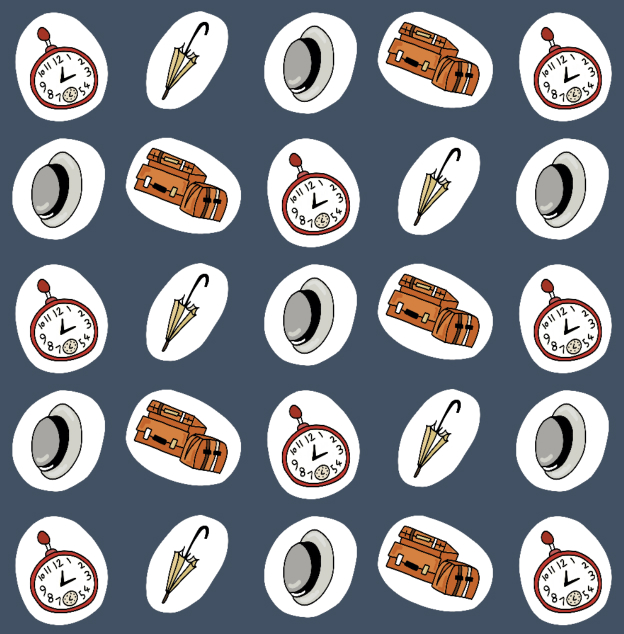
    Platform 9 print with pocket watches, umbrellas, hats and leather trunks on slate blue

    Steam billows from the train as battered leather trunks are loaded on. Ladies in fine hats wait at the platform edge, clutching their tickets.

    Learning to sew on Nanna’s machine

    I learned to sew on Nanna’s heavy 1950s semi-industrial machine. At 9 years old, I had to ask an adult to lift it onto the table for me! Nanna showed me how to guide the fabric like a professional machinist.

    She told me that in the factories you weren’t a proper machinist until the needle had gone through your finger. It proved you were fast and not afraid of the machine. Then you had to sit and wait for the engineer to unscrew the needle!

    Learning so young led me to study textiles and fashion, and later to teach it.

    A short history of Victorian prints

    In Victorian times, Manchester was nicknamed Cottonopolis, and the mills around it printed cotton for customers all over the world. At the other end of the scale, designer William Morris brought back slow, traditional hand block printing. His patterns of birds, leaves and twisting vines still define the Victorian look today.

    Victorian style is popular again in steampunk fashion. Steampunk fabrics often borrow drawings from old Victorian adverts and medical books, rather than the florals people actually wore.


    Make it yourself

    I’ve made all sorts of things from these prints, and you can make them too with my free sewing cards. Every make takes 2 hours or less. Tap a photo’s caption to see how.

    These fabrics aren’t on sale right now, but I hope to bring them back. Subscribe below and I’ll let you know.

    See all my Storytelling Fabrics

  • Classic Cars and Caravans Vintage Fabrics

    Classic Cars and Caravans Vintage Fabrics

    My pride and joy is my original vintage Eriba Pan caravan. Old cars and caravans have so much style, and so much history: the owners they’ve had and the trips they’ve been on. This collection is inspired by classic vehicles and their stories.

    The prints

    Each print is a little scene I imagined from a vintage road trip.

    Dancing Night

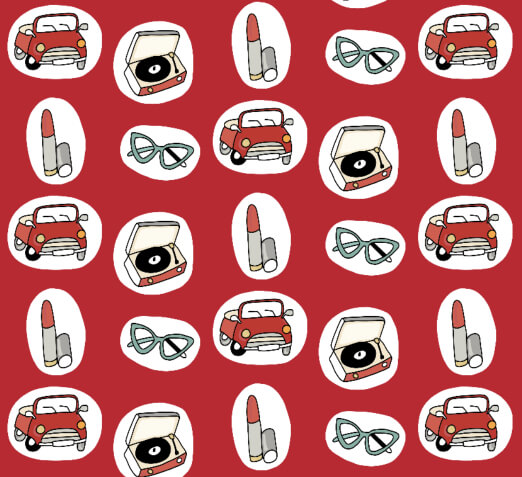
    Dancing Night print with red Minis, record players, lipsticks and cat-eye glasses on red

    All dressed up for a night of dancing with the girls, in a flared skirt, cat-eye glasses and heels. They pile into the Mini with a portable record player to get the party started.

    Campfire Evenings

    Campfire Evenings print with caravans, radios and flasks on mint green

    Lazy camping evenings in the Eriba Pan caravan. Toasting marshmallows on the campfire, sipping hot chocolate and gazing at the stars in the clear night sky.

    Drive to the Country

    Drive to the Country print with Beetle cars, cameras, radios and cases on mustard

    Driving the Beetle through the rolling hills of the Lake District, for a relaxing picnic by the lake.

    Beach Walks

    Beach Walks print with VW campervans, flasks, cameras and cool bags on burnt orange

    All packed up in the VW campervan, parked next to the beach. Time to watch the sea with a cup of tea.

    A family day out: an imagined story, based on real history

    Time for a Sunday drive. The family piles into the Mini, made by the British Motor Corporation, for lunch in Preston. It’s their very first trip on a motorway: the Preston Bypass, Britain’s first, which opened in 1958. It’s just 8 miles long, and there’s no speed limit yet!

    Next summer, the new motorway will make trips to Lytham St Annes quick and easy. They’ll camp in the family VW campervan, play in the sea, fly kites, visit the arcades and eat fish and chips on the way back to the campsite. Happy family memories in the making.

    A short history of 1960s prints

    Britain in the 1960s exploded into colour. Young people had more money and more jobs than ever before, and British music, art and fashion led the world: the Beatles, David Hockney and Mary Quant, whose Bazaar boutique on the King’s Road was the place to shop. Young women wore short skirts, PVC boots and shift dresses, perfect for dancing after a day at work.

    1960s fabrics were bold: flower power, psychedelic swirls and repeating geometric shapes, from designers like Emilio Pucci and Zandra Rhodes. New man-made fabrics like nylon and polyester took bright dyes that didn’t fade in the wash.

    Original 1960s fabrics are now collectable. Prints by Barbara Brown for Heal’s can be expensive, so reproduction fabrics are a good option if you’d like to sew your own shift dress.


    Make it yourself

    Fun prints make fun makes, perfect for packing for a trip away. Pick a fabric you love and make your own with my free sewing cards. Every make takes 2 hours or less.

    These fabrics aren’t on sale right now, but I hope to bring them back. Subscribe below and I’ll let you know.

    See all my Storytelling Fabrics

  • Home and Kitchen Vintage Fabrics

    Home and Kitchen Vintage Fabrics

    Going to Nanna and Grandad’s house was like stepping back into the 1930s and 40s. It was so cosy. Nanna taught me to make jam, bake pies and knit, and this collection is inspired by those visits.

    The prints

    Each print is a little scene I imagined from those days.

    Jam Making

    Jam Making print with kettles, scales and kitchen tools on green

    A morning spent picking blackberries along the country lanes. The sugar is weighed, the jars are ready and the water is boiling for an afternoon of jam making.

    Pie Making

    Pie Making print with rolling pins, mixing bowls and spoons on pale green

    The Aga warms the tiled kitchen floor. Flour, butter and a dash of milk make a lovely crust for tonight’s chicken pie and gravy.

    Home Sweet Home

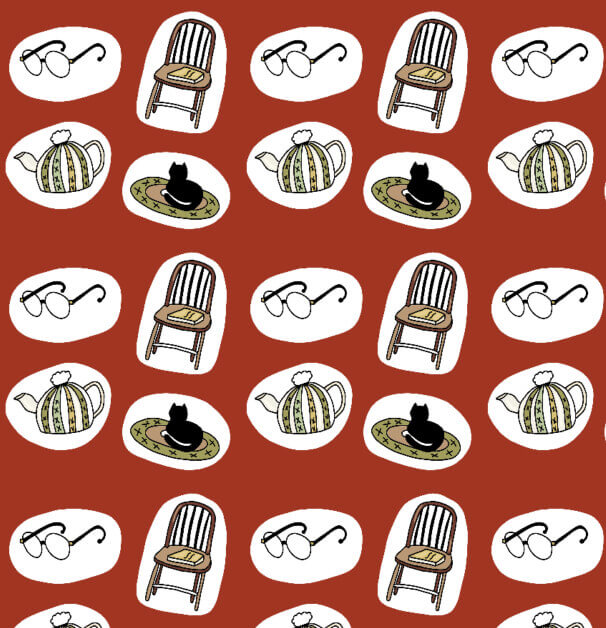
    Home Sweet Home print with chairs, teapots, cats and glasses on red

    A cold winter’s Sunday afternoon. The cat is curled up on the rug by the coal fire, and it’s time to settle down with a pot of tea and a good book.

    Knitting Break

    Knitting Break print with knitting, clocks, radios and teacups on taupe

    The front step is scrubbed and the windows cleaned with vinegar and newspaper. Time for some knitting from Woman’s Weekly in front of the television.

    Lilly’s story: an imagined life, based on real history

    To design this collection, I imagined a woman from the make do and mend generation. Lilly is made up, but her story is based on real history.

    During the Second World War, Lilly managed a munitions factory in Manchester. The bombing was fierce during the Manchester Blitz, with Salford Docks and the city’s warehouses among the targets. Lilly helped with the injured when Salford Royal Hospital was hit. After a night in the air-raid shelter, she still went to work the next day.

    When the war ended, so did her job. Men needed work, and women were expected back in the home.

    Rationing carried on for years, so Lilly never threw anything away. Every scrap of food and fabric was used. She turned her husband’s old suit into a skirt, and knitted scarves, hats and jumpers while listening to the wireless.

    A white wedding was a luxury, so Lilly married in a homemade dress of green crepe, embroidered with green beads. She married the same year as Princess Elizabeth, and it felt wonderful to have something to celebrate again.

    A short history of 1930s and 1940s prints

    1930s fabrics had a cosy, homely feel: florals, polka dots, tartans and little animals, in soft peaches, pinks, lilacs and blues. It was the era of the tea dress, with puffed sleeves, ruffles and belted waists. Times were hard during the Great Depression, and many women made their own clothes because it was cheaper than buying them.

    My favourite 1930s story comes from the USA. Families made dresses from the cotton sacks that flour and animal feed came in. When the mills noticed, they began printing the sacks with pretty patterns so they could be used for dressmaking.

    In the 1940s, clothing and fabric were rationed, and women were encouraged to make do and mend. Men’s suits became women’s skirts and jackets, scraps became patchwork quilts and rag rugs, and after the war old blackout curtains became dresses and pyjamas. Some lucky brides even wore parachute silk.


    Make it yourself

    Just like Nanna, you can make useful, cosy things for your home. Pick a fabric you love and make your own with my free sewing cards. Every make takes 2 hours or less.

    These fabrics aren’t on sale right now, but I hope to bring them back. Subscribe below and I’ll let you know.

    See all my Storytelling Fabrics

  • Edwardian Vintage Fabrics

    Edwardian Vintage Fabrics

    My second collection was inspired by old postcards I found in a stone terraced house. They date from the 1910s and 1920s, full of old photographs and messages of love.

    The prints

    Each print is a little scene I imagined from the postcards.

    Invitation for the Lady

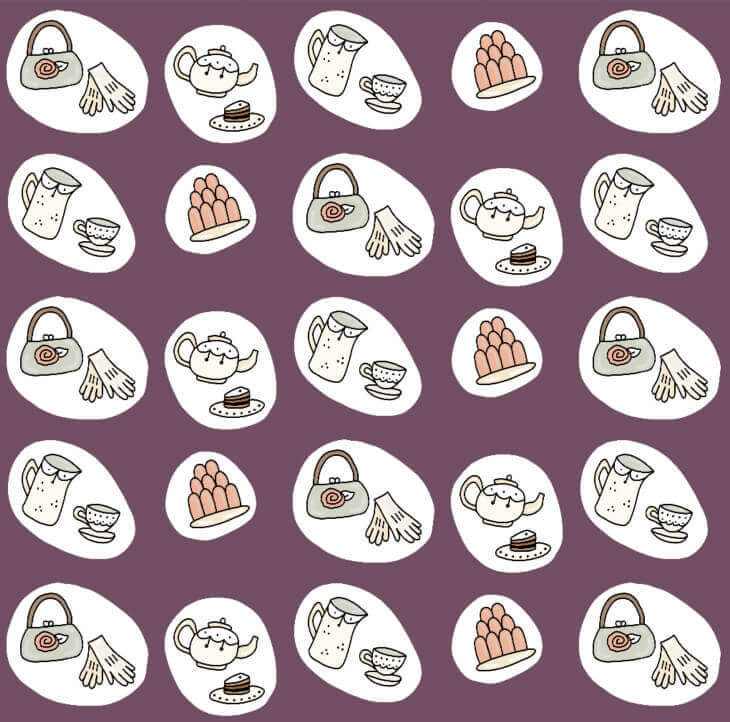
    Invitation for the Lady print with teapots, handbags and cakes on mauve

    An invitation to afternoon tea, such an honour! A fine spread of Victoria sponge, jellies from moulds and lace doilies, with a blouse to match.

    Remember Me

    Remember Me print with envelopes, silhouettes and ships on pink

    Take this token of love to remind you of me. Since seas divide us, keep a piece of me, so you will never forget me.

    Dear Alice

    Dear Alice print with Edwardian ladies and flowers on yellow

    “Dear Alice, I do wish I could take you by the hand in the good old-fashioned way and walk along the lanes of our childhood, where the hedges were fragrant with wild roses and honeysuckle.”

    A Day to Remember

    A Day to Remember print with crowns and rings on purple

    A day we thought would never come. Dancing in the street, bunting up high, we laughed, cheered and partied long into the night.

    Penelope’s story: an imagined life, based on real history

    To design this collection, I imagined a young woman living in Edwardian Manchester. Penelope is made up, but her world is real.

    Penelope’s family once made its fortune in the cotton mills. Now they are comfortably middle class, and a great aunt has paid for Penelope to attend finishing school, where she learned the strict rules of etiquette.

    Today she wears a lilac satin skirt, free from the corset in the new style of French designer Paul Poiret. She adds long gloves and a wide-brimmed picture hat, decorated with silk bows, lace and feathers, and made in Stockport, Manchester’s famous hat-making town.

    A letter has arrived, addressed “An invitation for the lady”: afternoon tea with Manchester’s women of influence, at a fundraiser for the suffragettes. Over Victoria sponge, the ladies talk politics. War is looming. Penelope holds tight to a love token from her fiancé, far away across the sea. Will she ever see him again?

    Researching the collection

    I designed this collection while studying for a Textiles MA at Manchester School of Art. I researched Manchester’s Edwardian history at:

    A short history of Edwardian and 1920s prints

    The Edwardian era, from 1901 to 1910, was an optimistic time after the Victorian age. Art nouveau was in fashion, with flowing patterns inspired by flowers and nature, and Liberty of London became famous for its art nouveau fabrics. Grand department stores like Selfridges became symbols of glamour.

    After the First World War came the roaring twenties and art deco, with bold geometric shapes and plenty of gold on dark backgrounds. Sonia Delaunay designed brightly coloured geometric fabrics based on her abstract paintings, and her ideas went on to influence the bold prints of the 1960s and 70s.


    Make it yourself

    These prints were made for simple, pretty makes. Pick a fabric you love and make your own with my free sewing cards. Every make takes 2 hours or less.

    These fabrics aren’t on sale right now, but I hope to bring them back. Subscribe below and I’ll let you know.

    See all my Storytelling Fabrics

  • Traditional English Festivals Fabrics

    Traditional English Festivals Fabrics

    This collection began with a photograph of my Nanna Betty, taken when she was crowned Rose Queen in Salford in the 1920s.

    Nanna’s Rose Queen story

    Rose Queen festivals were a much-loved summer tradition across Salford and Manchester. Girls walked through the streets in their best dresses, and one of them was crowned Rose Queen.

    For Nanna, being chosen was a treasured memory she held close all her life. I love to imagine the streets decorated with flags, ribbons and roses, with friends, family and neighbours lining the route to cheer her on.

    Festivals like this brought the whole community together. Everyone dressed in their best clothes and joined in, and the memories were passed down through the generations, just as Nanna passed hers down to me.

    The prints

    Rose Queen

    Rose Queen print with crowns and dancing shoes on brown

    Crowns, roses and dancing shoes, for one very special day in a young girl’s life.

    More festival prints


    Make it yourself

    Make something special for your own celebrations. Pick a fabric you love and make your own with my free sewing cards. Every make takes 2 hours or less.

    These fabrics aren’t on sale right now, but I hope to bring them back. Subscribe below and I’ll let you know.

    See all my Storytelling Fabrics